Meet Sara, a young entrepreneur from Karachi. She has just launched a line of herbal tea blends. She came up with the brand name, sketched the packaging by hand, wrote a lovely story about the recipe on the box, and even built a clever tea bag that never leaks. Her cousin asks, “Is all of this legally protected?”
Sara freezes. She has heard the words patent, copyright, and trademark for years, but she couldn’t say which one covers what.
If that sounds familiar, this guide is for you. Here is the difference between patent, copyright, and trademark, explained through Sara’s tea business so it sticks.
A Quick Picture Before the Details
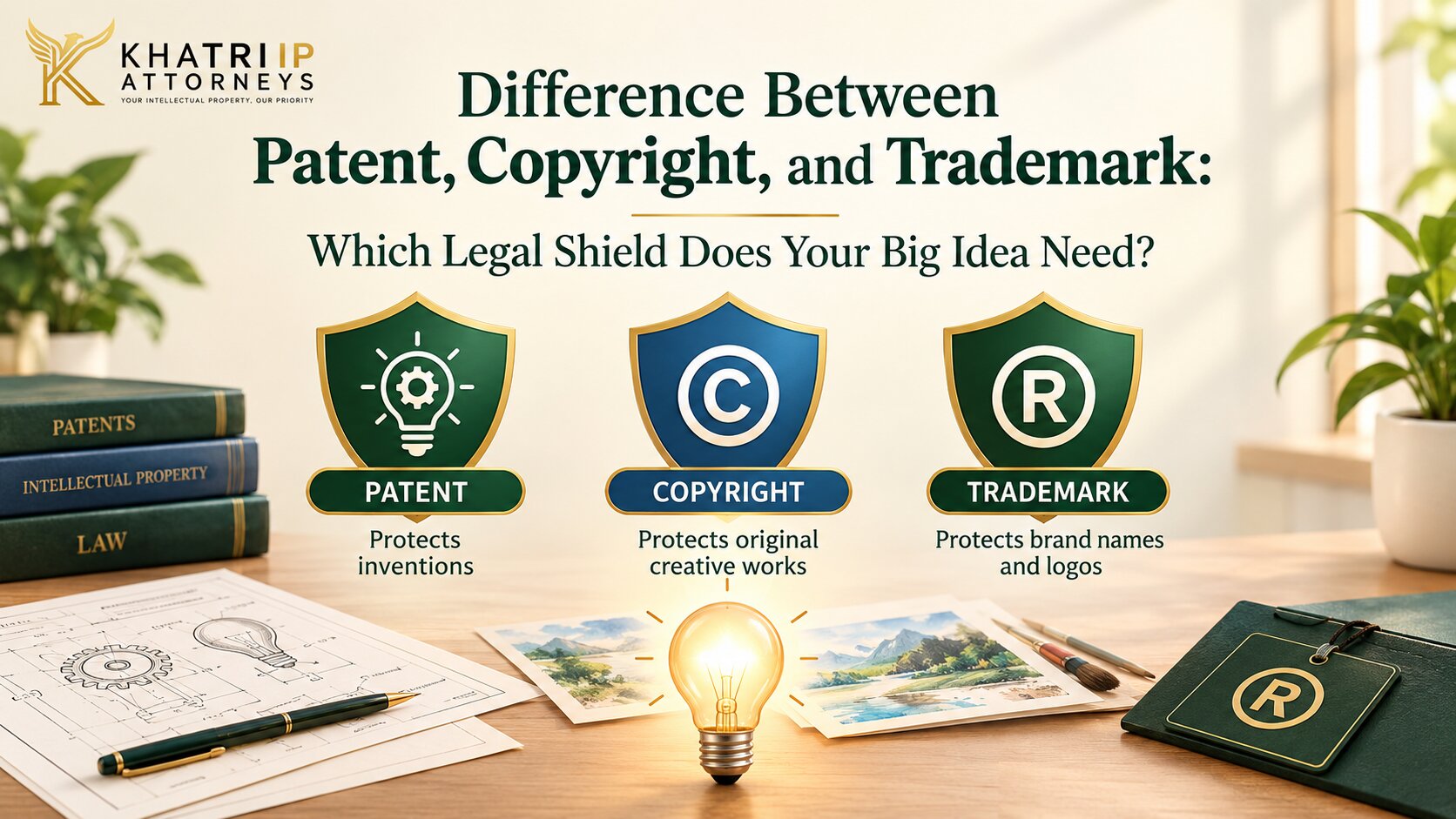
Think of your business as a house with three separate locks:
- The front gate is your name and logo. It tells people whose house this is.
- The art and furniture inside are your creative work. They were made by you and nobody else.
- The secret workshop in the basement is your invention. It’s where the clever mechanism lives.
Each of these needs a different key, and one key won’t open the other locks. In legal terms:
| Part of your business | Right that protects it |
|---|---|
| Name, logo, slogan | Trademark |
| Written, artistic or digital creations | Copyright |
| New inventions and methods | Patent |
Now let’s go through each one.
Trademark: The Face of Your Brand
A trademark is the sign customers use to recognize you in a crowded market. When Sara’s tea sits on a shelf next to ten other brands, her name and logo are what make a shopper say, “That’s the one I liked.”
A trademark can be:
- A business or product name
- A logo or symbol
- A tagline or slogan
- A distinctive label or package shape
What a trademark does for Sara
Suppose a competitor opens a shop called something almost identical to Sara’s brand and sells similar tea. Customers get confused. Some buy the wrong product, have a bad experience, and blame Sara. A registered trademark gives her a legal basis to stop that.
What a trademark does not do
It doesn’t stop anyone from brewing the same tea or writing about herbal blends. It only stops others from using a name or sign that misleads customers into thinking their product is hers.
A point many owners miss
Registering your company with the corporate authorities does not give you ownership of the brand name in the trademark sense. These are two different registrations. A name can be cleared for your company and still clash with someone else’s trademark.
Because your brand is usually the first thing the public sees, most new businesses should look into trademark registration before spending heavily on signage, packaging or advertising.
Copyright: The Protection for Your Creative Work
Sara has written a charming story about her grandmother’s tea recipe, printed on every box. She has also designed illustrations and shot product photos for her website. All of this is creative work, and creative work falls under copyright.
Copyright covers things like:
- Articles, stories, product descriptions and blog posts
- Illustrations, paintings and graphic designs
- Photographs and videos
- Music and voice recordings
- Software code and website content
The golden rule of copyright
Copyright protects how you express something, not the idea behind it. Anyone is free to write a story about a grandmother and her tea. What they can’t do is copy Sara’s actual words and pictures.
Does it begin automatically?
In general, copyright arises once an original work is created. Registration is not what creates it, but registering gives you an official record. If a rival lifts your product photos or copies your text, that certificate makes it much simpler to show that the work is yours and to act against the copying.
When copyright matters most
It is especially valuable if you earn from content: designers, photographers, authors, musicians, video creators and software developers. Many small businesses forget that their website text, catalog photos and brochures all count as creative works worth guarding. If that sounds like you, take a look at copyright registration for the practical steps.
Patent: The Shield for Your Invention
Now to Sara’s leak-proof tea bag, which uses a special folding method nobody has tried before. That is an invention, and inventions are the territory of patents.
A patent gives the inventor the exclusive right to make, use or sell the invention for a limited period. In exchange, the inventor explains to the public how it works. After the patent period ends, anyone can use the invention freely.
What makes something patentable?
An invention generally has to pass three tests:
- It’s new. Nobody has publicly disclosed it before.
- It’s inventive. It isn’t an obvious tweak that any skilled person would have thought of.
- It’s useful. It can actually be made or used in industry.
What a patent does for Sara
If her folding method qualifies, a competitor can’t copy the leak-proof design and sell it as their own while the patent lasts. She could also license the technology to other tea companies and earn from it.
The catch: timing
This is where many inventors slip. If you show your invention publicly before applying, for example by posting a video, displaying it at an exhibition or pitching it without protection, it may no longer count as new. Keep it confidential until your application is filed.
A patent is also not a casual step. It needs a detailed technical description and careful drafting, so it pays to understand the process of patent registration early.
Different Rights, Different Lifespans
One more way to tell the three apart is how long they last and how they are obtained.
- Trademarks can last as long as you keep renewing them and keep using the brand. They can, in principle, go on indefinitely.
- Copyright lasts for a long period tied to the creator’s life, so it often outlasts the creator.
- Patents are the shortest, lasting a fixed number of years, after which the invention belongs to the public.
The exact durations and renewal rules are set by Pakistani law, so always check the current requirements before you plan around any date.
Three Myths That Cause Expensive Mistakes
Myth 1: “I thought of it, so it’s automatically mine.”
Having an idea protects nothing by itself. Ideas must become a brand, a creative work or a patented invention before the law steps in.
Myth 2: “One registration covers everything.”
It doesn’t. Sara’s brand name, packaging story, and tea bag design are three separate assets with three separate protections.
Myth 3: “I’ll deal with this when someone copies me.”
By then, the damage is often done. Customers are confused, content is spread online, or your invention has been copied and sold. Protection is much cheaper before a dispute than during one.
So Where Should You Start?
You don’t need to register everything on day one. A sensible order for most businesses looks like this:
- Secure your brand identity first. Your name and logo appear everywhere, so protect them early.
- Then protect your creative assets. Product photos, written content, designs, and recordings come next.
- Finally, consider your inventions. If you’ve built something technically new, speak to a professional before you reveal it.
If you’re a creator with no physical product, start with copyright. If you’re a manufacturer with a new process, a patent may come first. Your priority depends on what your business is built on.
Bringing It All Together
Back to Sara. By the end of her research, she knew exactly what to do. Her brand name and logo needed a trademark. Her packaging story, illustrations, and photographs were covered by copyright. And her leak-proof design was a candidate for a patent, as long as she kept it private until filing.
That’s the real takeaway. The difference between patent, copyright, and trademark isn’t just legal vocabulary. It’s a map that shows you which part of your business needs which kind of protection. Once you know whether you’re guarding a name, a creation or an invention, the right path becomes much clearer.
If you’re still unsure where your own idea fits, a short consultation can save you months of guesswork. Khatri IP Attorneys supports startups, creators, and established businesses across Pakistan with exactly these questions, so you can build your brand knowing the foundations are secure.
Disclaimer: This article is for general information and isn’t legal advice. Laws, fees, and procedures can change, so consult a qualified IP attorney before making decisions.
